
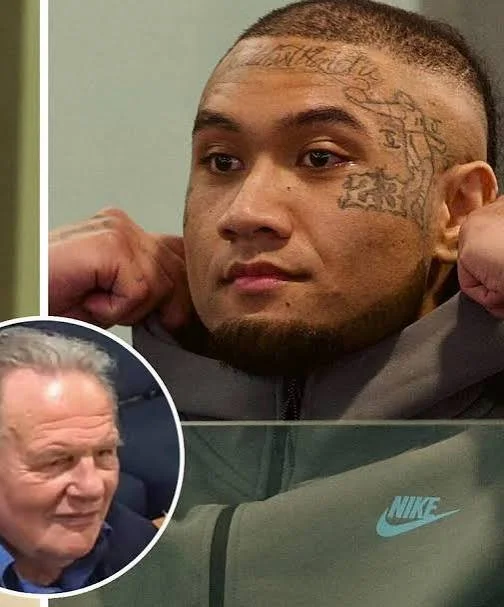
A gang “foot soldier” who murdered an “entirely innocent elderly man” amid a prison-orchestrated criminal underworld retribution scheme needs to seriously reflect on his misguided loyalties.
That was the advice handed out by Justice Michele Wilkinson-Smith this week as Crips-affiliated gunman Ethan Jessop, 26, stood in the dock for sentencing after five years of delays involving three High Court trials in Auckland.
“There was a time, Mr Jessop, and you won’t remember it, when gang members, when involved in disputes with other gangs, drew the line at targeting innocent bystanders or family members or homes containing elderly parents or children,” the judge said as she ordered a life sentence with a minimum imprisonment term of 17 years.
“That time seems to have passed.
“You should be ashamed of what you were a part of, and especially the decision that you made to shoot an elderly man who was just living out his life. He was a good man, valued in the community and by his family, and you had no right to end his life in that way.”
Jurors found Jessop guilty in September of having used a shotgun he nicknamed “Big Bad Beth” to fatally shoot 75-year-old Ōtāhuhu resident Peter Rasmussen, who his daughter described in a victim impact statement as “the epitome of a gentleman” and a kind and committed father.
Jessop, known by the street name “Crave”, had been sent to Rasmussen’s address by gang leader Lasalosi Vaitohi, who pleaded guilty to murder earlier this year. At a separate sentencing in July, Vaiotohi was also ordered to serve a life sentence with a 17-year minimum term of imprisonment.
The group had been seeking revenge against Rasmussen’s grandson, a Killer Beez gang member known as “Obey” who was suspected of having robbed their drug house a week earlier. But even if the younger Rasmussen wasn’t there, the plan was to shoot at the house to intimidate whoever was inside, the judge noted this week.
“The thing why we have to do this, so everyone knows that our gang ain’t to be f***ed with,” Vaitohi told Jessop three days before the fatal shooting.
“Sends a message, like you know, f***, our team is f***ing, siana [man] we’re the team now.”
Crips "foot soldier" Ethan Jessop shot Peter Rasmussen, 75, with a shotgun nicknamed "Big Bad Beth". Photo / Jason Dorday
On a follow-up call, he said: “That’s our style, cuz. We’ll just pull up, do the damn thing – no little chit-chat. F***, just do the damn thing”.
Both were members of 23 Blue Cartel, a local offshoot of the California-based Crips.
Vaitohi was already incarcerated in the weeks before the August 2021 shooting. His phone calls directing the violence in thinly veiled code were recorded and later played for jurors.
On a call with another associate, Vaitohi was warned Obey’s grandfather lived at the same address.
“I don’t care,” Vaitohi responded. “I don’t give a f***.”
He suggested to the associate he’d order “the boys” to wait outside the house for the younger Rasmussen to emerge then “just thing him right there”.
Lasalosi Vaitohi, in a mugshot released by police in 2013.
“It gives us a chance to test out our soldiers,” he said. “At the same time as teaching the world a lesson.”
In a call with another gang associate, Vaitohi was recorded trying to source a gun.
“It’s only going to come out for a 187,” the associate told Vaitohi – allegedly a reference to section 187 of the California penal code, which defines the charge of murder.
Vaitohi replied: “Yeah, yeah, yeah, tell him yeah, we need this one.”
Jessop, the judge said, wasn’t pulling the strings but was a valuable foot soldier because of traits that could have served him well in life had his loyalties not lain with his gang.
“You have a level of courage. You have a level of willingness to sacrifice yourself for the good of the gang,” Justice Wilkinson-Smith said. “Those qualities that could have been personally good characteristics, and you’ve used them in the wrong way.”
An armed officer guards the scene amid the 2021 Covid-19 lockdown when Peter Rasmussen was fatally shot outside his home. Photo / Michael Craig
Murder in most cases carries a life sentence with a minimum term of imprisonment of at least 10 years. In cases involving “calculated or lengthy planning”, the minimum term of imprisonment may be increased to at least 17 years.
Jessop’s lawyer, Emma Priest, argued her client shouldn’t be subjected to the 17-year minimum because the killing of the wrong man was a “reckless murder” – meaning he consciously ran the risk of death when he pulled the trigger but didn’t specifically intend to kill Rasmussen. The judge agreed, noting that while there was “calculated planning” in the scheme, it wasn’t by Jessop.
The judge also considered whether a 10-year minimum might be considered manifestly unjust because of Jessop’s “youth” at the time of the shooting. He was 21. While youth discounts are often applied for defendants into their mid-20s – considered the point at which the brain has fully developed – murder cases in which the 10-year minimum has been disregarded usually involve much younger defendants and other extenuating circumstances, the judge noted.
“You were not a mature adult,” Justice Wilkinson-Smith said. “[But] youth alone is not enough, and that is important because this court does not want to encourage gangs, in particular, to place guns in the hands of younger members and associates on the basis that they will escape a life sentence by virtue of youth.
“That is not the case, and anyone thinking of getting involved in a gang shooting should know that youth alone will not displace the presumption of life imprisonment.”
Peter Rasmussen was shot outside his Ōtāhuhu home on August 22, 2021.
Justice Wilkinson-Smith ordered a non-parole starting point of 16 years for the murder charge, then she uplifted it to 18 years after taking into account two prison attacks that Jessop was also in court to be sentenced for.
In April 2024, Jessop and two others repeatedly punched and stomped another inmate at Auckland Prison in Paremoremo, also using a shank to stab the man repeatedly in the head and neck. He was charged with injuring with intent to injure.
The second attack, resulting in a wounding with intent to injure charge, took place at Rimutaka Prison in June last year. Jessop punched that victim to the ground then stabbed him more than 50 times with a small object believed to be a pen or pencil.
The judge declined a request by the Crown to increase the non-parole period for another year because of Jessop’s criminal history, which included 18 convictions dating to 2017 and many Youth Court notations.
She also declined a request from the defence to reduce the non-parole range based on Jessop’s background. The defendant reported a positive upbringing, the judge noted. He is the only person in his family who is gang-affiliated, having chosen to join a group while still in primary school.
Justice Wilkinson-Smith did allow a one-year discount for Jessop’s youth at the time, resulting in the final 17-year non-parole period.
Justice Michele Wilkinson-Smith oversees the sentencings of two Crips members in the High Court at Auckland. Photo / Jason Dorday
In a separate hearing immediately after Jessop left the dock, Justice Wilkinson-Smith sentenced co-defendant Daziea Leslie Huia, 23, to four years and nine months’ imprisonment. Prosecutors had sought a murder conviction against Huia, but jurors instead found him guilty of manslaughter.
It is likely that Huia, a fellow Crips member known as “Aggro”, was not present at the scene when the shooting took place, the judge said. But he had previously discussed revenge plans with the gang leader and had been the one to find Rasmussen’s address. He aided Jessop by finding a car for him to use on the day of the shooting.
“You did not know that a 75-year-old man would be the victim of the plan you joined, but that is what happened,” the judge said. “You were clearly willing to be involved in a plan that was highly dangerous.”
She ordered a starting point of eight years but allowed discounts for having been just over 18 years old at the time, for his ADHD diagnosis, for his proposal before the trial – ultimately rejected by the Crown – to plead guilty to manslaughter, and for his difficult upbringing. The court was told he suffered neglect as a child and began using methamphetamine at age 14.
Because of the five years he has spent in custody awaiting the outcome of the case, Huia is likely to be released soon.
“I am really concerned that you will hurt someone, Mr Huia,” Justice Wilkinson-Smith told the defendant. “That will be terrible for that person, and it will ruin your life.”
Daziea Leslie Huia appears in the High Court at Auckland for sentencing after a jury found him guilty of manslaughter. Photo / Jason Dorday
As she had with Jessop, she encouraged the defendant to rethink his gang allegiance.
“You have given up too many years of your youth to violence and imprisonment,” she said. “Only you can decide to change that, but it’s not too late. How you choose to behave in the next few years will determine if you get to experience your 30s as a free man.
“You have not really been free since you were a young child.”
Jessop, Vaitohi and Huia first sat before a jury in 2023, but that trial was quickly aborted for a reason that the court has ordered to remain secret for the past three years. The interim suppression may lapse by the end of the year.
A second trial, in May last year, ended with a hung jury.
Craig Kapitan is an Auckland-based journalist covering courts and justice. He joined the Herald in 2021 and has reported on courts since 2002 in three newsrooms in the US and New Zealand.